
OYA MAG • BEAUTY TIP
Spots, shaving, ingrown hairs, sun: understand where dark spots on men’s faces come from and build a routine to help them fade, without trying to lighten your skin.

Spots, ingrown hairs, shaving, sun: in men with Black, brown and mixed-race skin, several factors can leave lasting dark marks. Here is how to understand where they come from and build a suitable routine, without trying to lighten your natural skin colour.
Why are dark spots so common?
Melanin gives skin its natural colour. After inflammation (a spot, shaving irritation or a wound), its production and distribution can be disrupted. A darker area can then persist: this is post-inflammatory hyperpigmentation.
It affects all skin types, but marks are often more visible and longer-lasting on melanin-rich skin. A flat mark is not necessarily a scar, which can also change the skin’s texture. Cosmetic products target the appearance and evenness of the complexion, not a change in natural skin colour.
The five main causes in men
1. Spots and acne
An inflamed spot can leave a brown mark once it has gone. Picking or scratching increases the risk of marks. Painful or persistent acne calls for a dermatologist’s advice. To learn more, read our article on treating acne-related dark spots.
2. Shaving and ingrown hairs
Very curly hairs can grow back into the skin and cause pseudofolliculitis barbae, especially on the neck and under the chin. Avoiding a close shave, shaving with the grain and using a trimmer that leaves a little length can help. Find out more: avoiding razor bumps on Black skin and reducing ingrown hairs.
3. Sun and visible light
Melanin offers partial, but not complete, protection against UV rays. Broad-spectrum sunscreen, at least SPF 30 and often SPF 50 in a dark spot routine, helps stop marks from darkening. For some types of pigmentation, a tinted sunscreen with iron oxides can also help against visible light.
4. Irritation and harsh products
Intensive scrubs, friction and layering irritating actives can keep inflammation going. A short, consistent routine is generally better.
5. Shaved scalp
The scalp can also show marks after shaving or folliculitis. If you have pustules, pain, hair loss or a persistent lesion, see a doctor to rule out another condition.
How to fade dark spots without lightening your skin
The priority is to identify and treat the cause of new inflammation. Gentle cleansing, moisturising, daily protection of exposed areas and a well-tolerated targeted treatment make a consistent approach.
Active ingredients studied for some types of hyperpigmentation include azelaic acid, vitamin C and certain retinoids; their use depends on the context and your skin’s tolerance, and some require a prescription.

My Dark Spot Correcting Serum MEL’OYA®
Apply in the evening, directly on dark spots on the face or body, without rinsing. On non-irritated, unbroken skin only, following the directions on the product page.
Discover the dark spot serum →Sun protection: an essential anti-dark-spot habit
Apply sunscreen to your face, ears, neck and scalp if it is uncovered, then reapply according to exposure, sweating or wiping your face.

My Sun Fluid SPF 50 SUN’OYA®
Broad-spectrum UVA/UVB SPF 50 fluid, applied in the morning as the last step on exposed areas and reapplied according to exposure.
Discover the SPF 50 sun fluid →Men’s face routine: morning and evening
In the morning
Cleanse
With a gentle product suited to your skin type.
Moisturise
With a suitable texture, mattifying if your skin gets shiny.
Protect
With broad-spectrum sunscreen on exposed areas.
In the evening
Cleanse
Without rubbing, to remove impurities and sunscreen.
Target
Apply a targeted treatment if suitable, following its instructions.
Moisturise
To keep the skin comfortable.

My Purifying Cleansing Foam CLEAN’OYA®
Apply to a damp face, morning and/or evening, then rinse. For sensitive skin, the CLEAN’OYA® range also includes a micellar water.
Discover the foam → See the cleansers →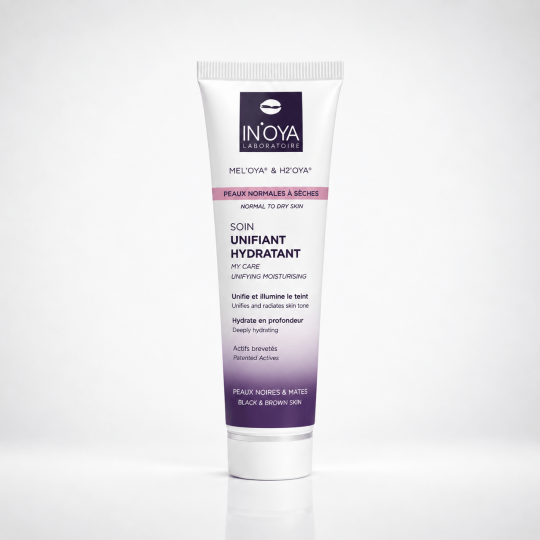
My “Unifying Moisturizing” Treatment MEL’OYA® & H2’OYA®
For normal to dry skin, without rinsing, morning and/or evening. A mattifying version exists in the MEL’OYA® range for combination to oily skin.
Discover the moisturiser →For a complete daily routine, also read our guide on how to care for your skin as a Black or mixed-race man.
How long does it take for dark spots to fade?
It depends on the cause, depth and age of the pigmentation. Some superficial marks take several months to fade, sometimes six to twelve months naturally once the cause is under control. No complete removal or fixed timeframe can be guaranteed.
When to see a doctor
See a doctor if a mark changes quickly, bleeds, becomes painful or appears for no reason; also for severe acne, recurring folliculitis, scarring or no improvement. To find the right specialist, read our article on finding a dermatologist for Black, dark or mixed skin tones.
Hyperpigmentation in Black men: what to remember
Hyperpigmentation in Black men often shows up as dark spots or post-inflammatory marks after acne, razor bumps, ingrown hairs and skin irritation. These marks are not necessarily scars: how they look and how long they last depend on the cause and skin type.
Prevention combines gentle cleansing, suitable moisturising, a cosmetic dark spot serum if your skin tolerates it, and broad-spectrum sun protection, ideally SPF 50. Sun protection helps stop marks from getting worse, including on Black, brown and mixed-race skin.
Frequently asked questions about dark spots in men
Sources and further reading