

OYA MAG • BEAUTY TIP
Bumps after shaving, itching, dark marks: practical steps to prevent ingrown hairs on the face and body without damaging the skin.

After shaving or hair removal, a hair can curl back and grow into the skin. It sometimes causes a bump or irritation and then, once the inflammation calms down, a darker mark. These reactions are often more visible on Black, brown and mixed-race skin.
What is an ingrown hair?
An ingrown hair grows back into the skin or cannot emerge normally. On the beard, very curly hairs can lead to pseudofolliculitis: small inflamed bumps after shaving, sometimes itchy.
It is not limited to the beard: the neck, underarms, legs and bikini line can also be affected after shaving or hair removal.
Why does darker skin keep marks?
Inflammation can trigger local melanin production and leave post-inflammatory hyperpigmentation. A flat mark is not necessarily a permanent scar: how it evolves depends mainly on repeated irritation and its depth.
Seven steps to prevent ingrown hairs
Choose a trimmer
Keeping a very short length rather than shaving bare reduces hairs growing back into the skin.
Prepare the area
Wet the skin, soften the hairs and use a well-tolerated shaving product.
Follow the hair growth
Avoid stretching the skin, going over the same spot or shaving against the grain. Use a clean, sharp blade.
Limit friction
Pat dry without rubbing and avoid tight clothing on irritated areas.
Moisturise gently
Choose a non-irritating product suited to your skin type. Avoid irritating actives on broken skin.
Don’t dig with a needle
Picking, scratching or digging increases the risk of infection and marks. Ask a healthcare professional for advice.
Exfoliate wisely
Scrubbing is not needed before every shave and should never be done on an inflamed area.
For a step-by-step shaving technique, read our advice on avoiding razor bumps on Black skin. If you have a beard, our guide on how to have a beautiful Afro beard covers trimming and care.
What to do if a bump appears
Stop shaving closely, cleanse gently, do not pick and keep an eye on it. Most isolated bumps calm down when the area is left alone.
If there is significant pain, spreading redness, pus, fever, frequent recurrences or scarring. Treating pseudofolliculitis and infections requires medical advice.
How to limit dark marks after an ingrown hair
The priority is to avoid new inflammation. Once the skin has healed, a gentle routine, suitable moisturising and broad-spectrum sun protection help avoid darkening the marks.
Marks can take several months to fade, and no timeframe or complete removal can be guaranteed. To learn more, read our article on how to remove dark spots safely.
IN’OYA routine: where each product fits
These products support skin care; they do not replace medical treatment for infection or persistent folliculitis.

My Purifying Cleansing Foam CLEAN’OYA®
Apply to a damp face, morning and/or evening, then rinse. For sensitive skin, choose the micellar water from the same range.
Discover the foam → See the cleansers →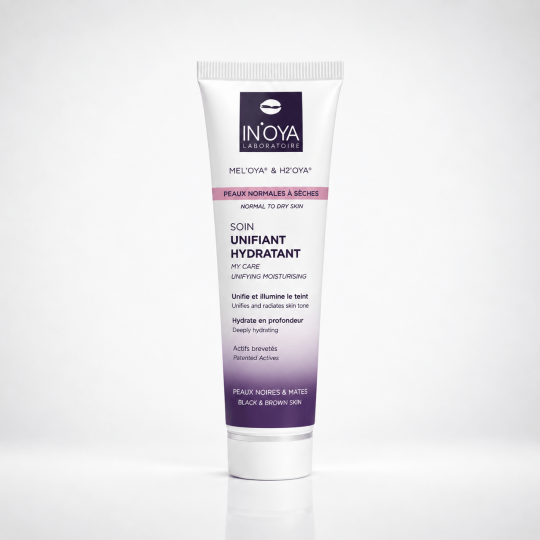
My “Unifying Moisturizing” Treatment MEL’OYA® & H2’OYA®
For normal to dry skin, without rinsing, morning and/or evening. A mattifying version exists in the MEL’OYA® range for combination to oily skin.
Discover the moisturiser →
My Dark Spot Correcting Serum MEL’OYA®
In the evening, directly on dark spots, only on healed skin. Do not apply to an open bump or a wound.
Discover the serum →
My Sun Fluid SPF 50 SUN’OYA®
In the morning, on exposed areas, especially when marks are visible. Reapply according to exposure.
Discover the sun fluid →Face, underarms, legs, bikini line: the areas affected
Under the arms, on the legs or along the bikini line, ingrown hairs appear mainly after shaving or hair removal, often made worse by friction from clothing. On Black and brown skin, inflammation can leave residual brown marks.
Adapt your hair removal technique, avoid repeated passes and keep exfoliation gentle, never on an inflamed or broken area. Do not remove an ingrown hair with a needle; see a doctor if the area becomes very painful, pus-filled or keeps recurring.
Frequently asked questions about ingrown hairs
Sources and further reading