
DOCT’OYA • EXPERT SKIN HEALTH GUIDANCE
Psoriasis on Black Skin: Symptoms, Causes and Treatment
Learn how psoriasis can look on Black and darker skin tones, what treatments can help, how long improvement may take, and why dark or light marks can remain after a flare.
IN’OYA Editorial Team · Published: 16 October 2026 · Last updated: 16 October 2026
For World Psoriasis Day on 29 October, the International Federation of Psoriasis Associations (IFPA) is highlighting young people living with the condition and encouraging everyone to “Look Beyond My Skin”. This matters for Black and darker skin tones, where psoriasis does not always appear red as it is often shown in medical images. Psoriasis can affect more than the skin: tell a healthcare professional about joint pain or changes to your nails.
In this article
Psoriasis Can Affect Every Skin Tone
Psoriasis is a chronic, non-contagious inflammatory skin condition that often flares up and settles down. It can cause raised plaques, scaling and itching, and affects people of every skin tone. In France, around one-third of cases begin before the age of 20.
The commonly pictured form—red plaques covered with white scale—mainly reflects how psoriasis appears on lighter skin. It does not represent every presentation. On more deeply pigmented skin, redness may be less obvious and plaques can appear in different colours.
Psoriasis on Black Skin vs. White Skin: What’s the Difference?
The condition is the same, but its visible colour can differ. Here are some common features to look for.
The main treatment principles are similar across skin tones. A dermatologist will also consider post-inflammatory marks, the areas affected and your preferences. Phototherapy can darken the skin and make some marks more noticeable, so raise this concern before treatment begins.
What Does Psoriasis Look Like on Black or Darker Skin?
- Plaquesthat may look purple, dark brown or grey, and are often raised with clearly defined edges.
- Scalethat may look grey, white or silvery on dry skin.
- Symptoms: itching, burning, soreness or cracking—describe these to your healthcare professional.
- Common areas: scalp, elbows, knees, lower back, skin folds and nails.
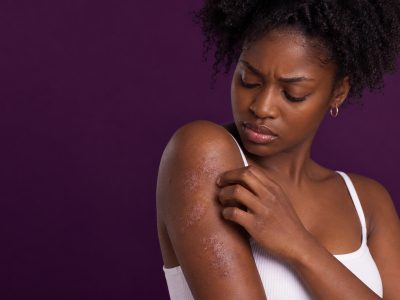
Appearance varies from person to person and by body area. The illustrations below show some possible presentations for educational purposes only; they cannot be used to diagnose psoriasis.

Raised, clearly defined plaques may appear purple or dark brown.

Small, scattered spots may appear across the torso and limbs.

In skin folds, patches may be smooth and have less visible scaling.
Do these symptoms look familiar?
Images alone cannot confirm a diagnosis. A healthcare professional can examine the affected skin and recommend appropriate care.
Understanding psoriasisExplore treatment options
MEL’OYA® Dark Spot Serum
Once the flare has settled and the skin is calm, it may help improve the appearance of dark marks.
It does not treat psoriasis and should not be applied to active plaques.
DISCOVER THE SERUM →Psoriasis Itching: How to Soothe Your Skin Without Worsening Plaques
Itching is common with psoriasis, although its intensity varies. Scratching can further irritate the skin, worsen plaques and cause breaks in the skin.
- Apply a clean, cool, damp compress for a few minutes to help ease the urge to scratch.
- Moisturise regularly with a suitable emollient, preferably fragrance-free, especially after showering. Dry skin can make itching worse.
- Choose short, lukewarm showers and avoid rubbing or scratching plaques. Be gentle when handling hair and scale on the scalp.
These steps may ease discomfort, but they do not replace psoriasis treatment. Speak to your dermatologist if itching is severe, disrupts sleep or continues despite care. Do not add medication or anti-itch products without advice from a healthcare professional.
Psoriasis plaques
A plaque may be raised, clearly defined and covered with scale. On darker skin, it may look purple, brown or grey, with greyish or pale scaling.
Scalp psoriasis
The scalp may develop thick plaques and scaling that sometimes extend beyond the hairline. Other scalp conditions can look similar, so a clinical examination is important.
Guttate psoriasis
This form can cause small, drop-shaped spots, often on the torso or limbs. A sudden or widespread rash should be assessed by a healthcare professional.
Inverse psoriasis (skin folds)
In skin folds, patches may be smooth, shiny and less scaly than typical plaques. Several conditions can look alike in these areas, so seek advice for persistent irritation.
Psoriasis, Eczema or Seborrhoeic Dermatitis on Dark Skin: How to Tell the Difference
Several skin conditions can look alike. On darker skin, colour alone is not a reliable guide. A clinician will consider texture, location, itching and how the patches developed. This table offers general clues, not a diagnosis.
These conditions can occur together. A clinical examination—and sometimes a skin sample or biopsy—is needed to tell them apart. Do not apply leftover steroid or antifungal medication prescribed for a different episode to an undiagnosed lesion.
What Causes Psoriasis?
The exact cause is not fully understood. Current evidence links psoriasis to genetic susceptibility and an immune-driven inflammatory response that speeds up skin-cell turnover. Having a family history increases risk, but does not mean you will definitely develop the condition.
In someone who is predisposed, certain triggers may start or worsen a flare. These can include an infection, skin injury or friction, significant stress, some medicines, cold weather or dry air. Triggers differ from person to person. Smoking and alcohol may worsen psoriasis or make it harder to manage. Never change a prescribed medicine without medical advice.
Scalp Psoriasis and Textured Hair: What Should You Know?
The scalp is a common site for psoriasis. If you have coily, curly or textured hair, treatment needs to work with your hair-care routine. The following practices are best avoided or discussed with your clinician:

Scaling and plaques can appear along the hairline or beneath the hair.
- Tight hairstyles(tight braids, ponytails, buns or weaves): pulling on the scalp can irritate it, trigger a flare and contribute to hair loss over time.
- High heat: avoid letting curling irons, straighteners or heated caps touch the scalp, as heat can irritate or burn it.
- Relaxers, hair dye and perms: these chemical treatments may trigger a flare. Avoid them during a flare and ask your clinician before using them.
- Scratching: brush and comb gently; scratching or scraping the scalp can make a flare worse.
Treatment may come as a lotion, foam, solution or medicated shampoo. Tell your dermatologist how you style and wash your hair—including wash frequency, night-time protection and products—so they can choose an option that fits your routine. Patchy hair loss can occur around plaques; report it to your clinician.
Does a Dark Mark After a Psoriasis Flare Mean the Condition Is Still Active?
Not necessarily. After a plaque settles, the skin may remain darker (post-inflammatory hyperpigmentation) or lighter (hypopigmentation). These changes are not necessarily scars or proof that inflammation is still active. On medium to dark skin tones, marks may take around 3–12 months or longer to fade, and timing varies from person to person.
A change in skin colour can remain after plaques have settled; it does not automatically mean psoriasis is still active.
To assess progress, a clinician looks beyond colour and considers thickness, scaling, itching, tenderness and the history of the flare. Do not intensify treatment or start a skin-lightening or exfoliating product on your own to remove a mark. Ask the professional managing your psoriasis for advice.
Sun Exposure and Psoriasis: What to Know
For many people, moderate sun exposure may improve symptoms, but sunlight worsens psoriasis for around 5–10% of people. Sunburn can trigger a flare or contribute to new plaques.
- If you spend time outdoors, increase exposure gradually, avoid the strongest midday sun and use sun protection suited to your skin.
- Protect areas left marked after a flare: sunlight can make dark spots more noticeable. Apply broad-spectrum sunscreen to exposed skin.
- Medical phototherapy is carefully dosed and supervised. Tanning beds and prolonged sun exposure are not substitutes for treatment.
HELP PROTECT MARKS AFTER A FLARE
After a flare, protect exposed areas with broad-spectrum sun protection. SUN’OYA® SPF 50 Sun Fluid may be used on calm skin if well tolerated. It does not treat psoriasis.

SUN’OYA® SPF 50 Sun Fluid
SPF 50 UVA/UVB protection, designed to avoid white cast.
Use on calm skin if well tolerated. This product does not treat psoriasis.
DISCOVER THE SUN FLUID →Psoriasis Treatment: What Are the Options and How Long Do They Take?
Treatment depends on the type of psoriasis, where it appears, how extensive it is, its impact on daily life and your overall health. For localised psoriasis, a clinician may prescribe topical treatments such as corticosteroids or vitamin D analogues. Scalp treatments may include a medicated lotion, foam or shampoo. Moisturiser can support skin care, but it does not replace psoriasis treatment.
For widespread or severe psoriasis, or when topical treatments are not enough, a dermatologist may recommend phototherapy or systemic treatment taken orally or by injection, including biologic medicines. These treatments require a prescription and medical monitoring; they are not interchangeable and are not suitable for everyone.
There is no single timeline for psoriasis to “go away”. Improvement often takes several weeks and varies by treatment and individual. As one example, France’s national health insurance service notes that methotrexate may take 6–12 weeks to show an effect on lesions, while a course of phototherapy often lasts around two months. These are not guarantees; do not start, stop or change treatment without medical advice.
Why an Accurate Diagnosis Matters
When medical images mainly show bright-red plaques on lighter skin, signs on darker skin may be less familiar or harder to interpret. This can delay recognition of psoriasis. The medical resources listed at the end of this article offer further information.
A healthcare professional can examine your skin, scalp and nails and ask about your symptoms. Further tests may be considered if the lesions are unusual or the diagnosis is uncertain. Photos can help track changes over time, but they cannot replace an in-person assessment. Use the checklist below to prepare for your appointment.
Before Your Dermatology Appointment: What to Prepare
- Takedated photosof the affected areas in daylight and from the same angle to show how they change over time.
- Notewhenthe symptoms began, which areas are affected and what seems to make them worse (stress, cold, products or hairstyles).
- List yourmedications, supplements and productsincluding hair-care products such as relaxers, oils and shampoos.
- Tell your clinician aboutnail changes, joint pain or stiffness, and any family history of psoriasis.
- Prepare yourquestions: for example, pigment changes, phototherapy and treatment options that work with your hairstyle.
Psoriasis Can Affect More Than Your Skin
Tell a clinician if you have joint pain or swelling, morning stiffness, swollen fingers or toes, or nail changes. These symptoms may need assessment for psoriatic arthritis. They do not establish a diagnosis on their own.
For teenagers and young adults, visible plaques, itching or comments from others can affect confidence, relationships and everyday life. “Look Beyond My Skin” is a reminder that a person is more than their condition. Talking with a healthcare professional or patient support organisation may help you feel less alone.
Psoriasis at Different Ages and Life Stages
Psoriasis affects people of all genders, and plaque appearance cannot be generalised by sex. If you are pregnant, planning a pregnancy or breastfeeding, tell your clinician so your treatment can be reviewed. Do not stop treatment without medical advice.
When Should You Seek Medical Advice?
Book an appointment if plaques persist, spread, itch severely, become painful or keep returning, or if you are unsure what is causing them. Seek advice for joint symptoms or nail changes as well. If you develop a widespread rash with fever or feel seriously unwell,seek urgent medical care.
Psoriasis on Dark Skin: Frequently Asked Questions
What does psoriasis look like on Black skin?
It may cause raised purple, dark brown or grey plaques with grey, white or silvery scale. Appearance varies by person and body area.
How can you tell psoriasis from eczema on Black skin?
Psoriasis more often causes raised, well-defined plaques with scale. Eczema often causes less-defined, very itchy patches and thickened skin. The two can occur together; a medical examination is needed to tell them apart.
Why does a mark remain after a psoriasis flare?
A darker or lighter patch may remain after a flare. This change in pigmentation does not automatically mean inflammation is still active. A healthcare professional can help distinguish the two.
Can scalp psoriasis cause hair loss?
Localised hair loss can occur around plaques, particularly with scratching or tight hairstyles. Tell your clinician so they can assess the cause and adapt scalp treatment.
Is sunlight good for psoriasis?
Moderate exposure may improve symptoms for many people, but psoriasis worsens with sunlight for around 5–10%. Avoid sunburn and protect areas with pigment changes.
What treatments are available for psoriasis?
Depending on the type and severity, a clinician may prescribe topical treatments, recommend phototherapy or consider oral or injectable systemic treatment. Treatment selection and monitoring should be managed by a healthcare professional.
How long does psoriasis take to clear?
There is no universal timeline, and psoriasis is a chronic condition. Improvement depends on treatment; pigment changes may remain for several months after plaques settle.
Is psoriasis contagious?
No. Psoriasis is a chronic inflammatory condition and is not contagious. It cannot be passed on through touch or by sharing objects.
Need medical advice?
If you are unsure about any skin plaques, speak to a doctor or dermatologist. Online information cannot replace a medical examination.
Find a dermatologist experienced in treating Black and darker skin tonesLooking for information or support?
France Psoriasis provides information and resources for people affected by psoriasis.
Visit France PsoriasisPrepare for your appointment