
Acne & Blemishes — Skin Tones IV to VI
What cleansing routine is best for treating acne breakouts?
How pimples form, their causes, physiology, and the specific needs of darker skin tones: understanding acne is the first step to choosing the cleansing routine that truly makes a difference.
Reading time: 10–12 min | Science-based article & practical advice | Skin tones I to VI
01 — How a pimple forms
How a pimple forms: what really happens in the skin
To effectively fight acne, you first need to understand what is happening beneath the surface. The skin is not a simple envelope — it is a complex, layered, living organ. Its ability to clear impurities depends primarily on the pilosebaceous follicles — tiny canals from which each hair grows, connected to a sebaceous gland.
Under normal conditions, the sebaceous gland produces sebum, a lipid-rich substance that lubricates the skin's surface and maintains the integrity of the hydrolipidic barrier. This sebum naturally travels up through the follicular canal, carrying with it dead cells that shed regularly from the inner walls (a process called follicular desquamation).
Acne occurs when this natural clearing mechanism breaks down. Four major disruptions have been identified:
1. Excess sebum production
Overproduction of sebum, often driven by androgens, saturates the follicular canal and promotes blockage.
2. Infrafollicular hyperkeratosis
Abnormal build-up of keratinocytes (dead skin cells) inside the follicle, forming a solid plug.
3. C. acnes proliferation
The bacterium Cutibacterium acnes multiplies in this oxygen-poor, lipid-rich environment, triggering an immune response.
4. Inflammatory response
The immune system reacts to bacterial lipases and antigens, causing redness, heat and swelling — the visible pimple.
This cascade unfolds over several days or even weeks, long before the lesion becomes visible on the surface. This is why treating acne requires consistency: you are acting on a deep biological process, not simply on what you can see.
02 — The causes
The causes of acne: a multifactorial condition
Acne does not have a single cause — multiple factors intertwine and amplify one another. Understanding these drivers helps build a more effective skincare strategy.
Hormonal factors
Androgens — including testosterone and its active metabolite dihydrotestosterone (DHT) — directly stimulate the sebaceous glands. This explains why acne is particularly common during adolescence, menstrual cycles, pregnancy, or in cases of polycystic ovary syndrome (PCOS). Androgen receptors in sebocytes (sebaceous gland cells) respond to these hormonal fluctuations by increasing sebum production.
The role of the skin microbiome
The skin hosts billions of micro-organisms that make up the skin microbiome. In people prone to acne, certain phylogenetic subtypes of Cutibacterium acnes are over-represented. These bacteria break down sebum triglycerides into free fatty acids, which irritate follicular walls and activate inflammatory pathways via innate immunity receptors (particularly TLR-2).
Genetics
Twin studies have shown that heredity plays a significant role in acne — accounting for between 50 and 90% of variance in some severe forms. Genes involved in immune response, sebaceous regulation, and keratinocyte differentiation are all implicated.
Diet and lifestyle
Increasingly robust clinical data points to high-glycaemic-index foods and dairy consumption as aggravating factors. Insulin and IGF-1 (Insulin-like Growth Factor-1), stimulated by these foods, activate signalling pathways (mTORC1) that increase sebocyte proliferation. Stress amplifies the secretion of pro-inflammatory neuropeptides and adrenal hormones.
Environment and skincare products
Air pollution (fine particles PM2.5, polycyclic aromatic hydrocarbons), certain comedogenic oils, and an ill-adapted skincare routine are all aggravating factors that are often underestimated.
Did you know?
The word "acne" comes from the Greek acmé, meaning "peak" or "efflorescence". Today, it is estimated to affect 80% of teenagers and persists into adulthood in 25 to 40% of women and 10% of men.
03 — Forms of acne
The different forms of acne: a broad spectrum of lesions
Acne is not monolithic. Two major categories of lesions are distinguished, each with different therapeutic implications.
Non-inflammatory lesions (retentional)
| Lesion | Description | Main mechanism |
|---|---|---|
| Microcomedone | Precursor lesion, invisible to the naked eye | Early-stage follicular blockage |
| Open comedones (blackheads) | Kerato-sebaceous plug exposed to air | Lipid oxidation (darkening) |
| Closed comedones (whiteheads) | Blocked follicle with intact skin over it | Accumulation without air exposure |
Inflammatory lesions
| Lesion | Characteristics | Scarring risk |
|---|---|---|
| Papule | Red, solid spot < 5mm, tender to touch | Low to moderate |
| Pustule | Papule with visible pus-filled tip (white/yellow) | Moderate (if squeezed) |
| Nodule | Deep lesion > 5mm, congested | High |
| Cyst | Deep pus-filled cavity | Very high — atrophic scarring |
Severity classification (mild, moderate, severe) is based on the number and type of lesions. It guides the treatment approach: dermatological care is essential for nodular and cystic forms.
04 — Skin tones IV to VI
Specific concerns for skin tones IV to VI: acne with higher stakes
The Fitzpatrick classification divides skin tones into six categories, from the lightest (I) to the darkest (VI). Skin tones IV to VI include olive, mixed, Asian, and Black skin — all rich in highly active melanocytes. This melanocytic richness is responsible for a well-documented increased risk: post-inflammatory hyperpigmentation (PIH).
Skin tone IV
Olive / Mediterranean
Tans easily. Moderate susceptibility to PIH.
Skin tone V
Brown / Mixed heritage
Deep tan, rarely burns. High risk of PIH.
Skin tone VI
Black skin
Very rich in melanin, never burns. Very high risk of PIH and keloid scarring.
Post-inflammatory hyperpigmentation: the most common after-effect
When an acne lesion (even a minor one) forms on melanin-rich skin, the inflammatory response stimulates surrounding melanocytes, which overproduce melanin. The result: a dark mark, ranging from brown to near-black, that can persist for months or even years after the acne itself has cleared. These post-acne macules are often more visually impactful than the original blemish.
Keloid tendency
Darker skin tones carry a higher risk of hypertrophic and keloid scars — raised growths of scar tissue that extend beyond the original lesion boundary. Any unnecessary manipulation of lesions, or the use of overly aggressive actives, multiplies this risk significantly.
Often more pronounced seborrhoea
Studies have shown that people of sub-Saharan African origin have on average more numerous and more active sebaceous glands in certain facial areas, particularly the forehead and nose (T-zone). This functional hyperseborrhoea contributes to a greater tendency towards comedones and blemishes.
Ill-adapted cosmetic formulas: a systemic problem
Historically, dermatological and cosmetic research has focused on lighter skin tones. Standard anti-acne formulas frequently contain potentially drying or irritating actives — high-concentration benzoyl peroxide, denatured alcohol, certain AHAs at very low pH — which can destabilise the skin barrier of pigmented skin and, paradoxically, worsen hyperpigmentation. This is why specialist laboratories like IN'OYA have developed ranges specifically designed for these skin tones.
05 — The importance of cleansing
Why cleansing is the foundation of any acne treatment
Cleansing is often perceived as a routine, unremarkable step. In reality, for acne-prone skin — and especially for skin tones IV to VI — it is the foundation on which the effectiveness of all subsequent products depends. An inadequate cleanse can, on its own, maintain or worsen acne.
Unblocking the follicle
The primary role of cleansing is mechanical and chemical: removing excess sebum, dead cells accumulated on the surface, and impurities (pollution, make-up residue, environmental debris) that compound the follicular content. Without this cleanse, organic matter builds up, feeds C. acnes, and accelerates comedone formation.
Preparing the skin to absorb actives
An anti-acne treatment — whether it contains salicylate, niacinamide, zinc, or azelaic acid — penetrates far more effectively into skin that has been thoroughly cleared of surface impurities. Sebum film, particulate pollution, and make-up all form a mechanical barrier to active absorption. A well-executed cleanse multiplies the effectiveness of the products that follow.
Regulating the microbiome without disrupting it
A classic mistake in acne management is trying to cleanse "too hard" to kill bacteria. This is counterproductive: an overly aggressive surfactant or a highly disrupted pH destroys the beneficial commensal flora, damages the lipid barrier, and triggers a sebum rebound reaction (the skin overproduces sebum to compensate for dehydration). A gentle cleanser with a slightly acidic pH (close to the skin's physiological pH of 4.5 to 5.5) is the cardinal rule.
Preventing infection and inflammation
Regular cleansing mechanically reduces the bacterial load on the skin surface and in follicular ostia, decreasing the substrate available for C. acnes proliferation. It is both a preventive and a curative gesture.
Double cleansing: a strategy for make-up wearers
For those who wear foundation, BB cream, or SPF products, double cleansing is particularly relevant. Start with a cleansing oil or balm to dissolve oily residue and make-up (lipophilic phase), then follow with a foaming cleanser to remove water-soluble impurities and purify more deeply. This protocol, widely used in Korean skincare and now recommended by many dermatologists, delivers a clean slate without repeated aggression.
06 — The cleansing routine
How to cleanse acne-prone skin correctly
How you cleanse matters as much as what you use. An excellent foam used incorrectly can still deliver poor results.
CLEAN'OYA® — Step 1: Cleansing
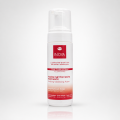
My Purifying Cleansing Foam
Specifically formulated for combination to oily skin on skin tones IV to VI, this cleansing foam delivers deep follicular decongestion while respecting the balance of the hydrolipidic film. Its light foaming texture leaves a feeling of freshness and clarity without any tightness — often a sign of induced dehydration.
Designed to prepare the skin to effectively receive the anti-blemish treatments that follow in the routine, it is the essential first step in a comprehensive approach to managing acne on pigmented skin.
Discover the Purifying Cleansing Foam CLEAN'OYA® →Key actives & benefits
Targeted purifying action Respects skin pH No drying agents Light foam texture Suited to skin tones IV–VI Non-comedogenic"A cleanse that prepares and potentiates — not just purifies."
Frequency: morning and evening — no more
Cleansing twice a day — morning and evening — is the frequency recommended by the vast majority of dermatologists. Going beyond this (3, 4 times) disrupts the skin microbiome, triggers a sebum-stimulating response, and weakens the barrier. After intense sweating (exercise), a rinse with plain water — without a cleanser — is sufficient.
07 — The complementary treatment
After cleansing: targeting blemishes with a dedicated treatment
Even the best cleansing routine cannot, on its own, treat acne lesions that have already formed. It is the essential first line of defence — but it must be complemented by a targeted active treatment, applied to freshly cleansed skin.
For skin tones IV to VI, the choice of this treatment is critical. Generic anti-acne actives can be too aggressive, cause irritation, and — paradoxically — stimulate post-inflammatory melanogenesis. A treatment designed for pigmented skin must simultaneously act on blemishes and prevent residual dark marks.
ACN'OYA® — Step 2: Treatment
My Anti-Blemish Skincare
This IN'OYA anti-acne treatment was developed with the biological specificities of pigmented skin in mind. It works in synergy with the Purifying Cleansing Foam: where the foam clears the surface, this treatment addresses lesions in progress and prevents new blemishes from forming.
Its formulation targets the bacterial component, excess sebum, and inflammation — while also incorporating anti-dark spot actives to contain the PIH risk characteristic of darker skin tones.
Discover the Anti-Blemish Skincare ACN'OYA® →Multi-target action
Targeted anti-bacterial Sebum-regulating Anti-inflammatory PIH prevention Suited to skin tones IV–VI Light non-comedogenic texture"Treat the blemish. Prevent the mark. Protect pigmented skin."
Common mistakes that make acne worse
❌ Squeezing pimples
Causes follicular rupture, spreads bacteria into the dermis, and multiplies the risk of scarring and PIH by 4 to 8 times.
❌ Over-exfoliating
Daily mechanical or chemical exfoliation strips the skin barrier, increases sensitivity, and can worsen inflammation.
❌ Using comedogenic products
Certain oils (coconut, cocoa butter) and occlusive silicones can accelerate follicular blockage on acne-prone skin.
❌ Skipping sun protection
Sun exposure dramatically worsens PIH. A non-comedogenic SPF ≥ 30 is essential in any acne routine for skin tones IV–VI.
❌ Changing products too often
Anti-acne actives need 4 to 12 weeks to show significant results. Impatience is the enemy of consistency.
❌ Neglecting hydration
Dehydrated skin overproduces sebum. Even oily, acne-prone skin needs a light, non-comedogenic moisturiser after cleansing.
The 4-week rule
Dermatologists recommend waiting at least 4 weeks before evaluating the effectiveness of a new anti-acne product. The epidermal cell renewal cycle lasts an average of 28 days. Some formulas need 8 to 12 weeks to reach their full potential — particularly regulating actives such as niacinamide or zinc.
Conclusion
A targeted, consistent routine adapted to your skin
Acne is a complex, multifactorial skin condition that requires a rigorous and personalised approach. For skin tones IV to VI, the challenge goes beyond simply treating breakouts: it means preventing the lasting dark marks that are often the most visible and enduring consequence.
At the heart of this strategy: gentle, regular, effective cleansing — complemented by a targeted treatment formulated for your skin type. The IN'OYA range was designed precisely to meet these specific needs, with a rigorous scientific approach and deep respect for the biological uniqueness of pigmented skin.
My Purifying Cleansing Foam CLEAN'OYA® My Anti-Blemish Skincare ACN'OYA®Sources & scientific references: Zaenglein AL et al., "Guidelines of care for the management of acne vulgaris", J Am Acad Dermatol, 2016 — Ghodsi SZ et al., "Prevalence, severity, and severity risk factors of acne in high school pupils", Dermatology, 2009 — Bourne S & Jacobs A, "Observations on acne, seborrhoea, and obesity", Br Med J, 1956 — Nouveau-Richard S et al., "Sebaceous gland distribution in different ethnic origins", IFSCC, 2004 — Fitzpatrick TB, "The validity and practicality of sun-reactive skin types", Arch Dermatol, 1988 — Del Rosso JQ, "The role of skin care as an integral component in the management of acne vulgaris", J Clin Aesthet Dermatol, 2013.
This article is for informational and educational purposes only. It does not replace medical advice. In cases of severe, nodular, or cystic acne, a dermatological consultation is recommended.