Science & Dermatology — Genetics & Pigmentation
Albinism through the lens of science: differences across Black, mixed and Caucasian skin
Biological mechanisms, genetic mutations, global prevalence and clinical specificities according to ethnic origin: a comprehensive and accessible scientific exploration.
Reading time: 12 min | Scientific article & popular science | Skin phototypes I to VI
01 — Biological foundations
What is albinism? The biological foundations
Albinism is a group of rare genetic disorders characterised by a total or partial absence of melanin, the pigment that gives colour to the skin, hair and eyes. This melanin is produced by specialised cells called melanocytes, located in the basal layer of the epidermis, in the hair follicles and in the retina.
In a person with albinism, melanocytes are present in normal numbers, but their function is impaired. The "factories" are there — it is the "production line" that is interrupted at one of its key stages.
The melanin synthesis pathway (melanogenesis)
Tyrosine (amino acid) → Blocked tyrosinase → DOPA / DOPAquinone → Eumelanin / Pheomelanin. In the majority of oculocutaneous albinism cases (OCA1), tyrosinase is non-functional, blocking synthesis from the very first step.
To date, scientists have identified more than 20 subtypes of albinism, grouped into two main categories: oculocutaneous albinism (OCA), which affects the skin, hair and eyes, and ocular albinism (OA), which primarily affects vision. To learn more about the African specificities of this condition, read IN'OYA's complete article on albinism in Africa.
02 — Genetics
The genetics of albinism: varied mutations across populations
Albinism is a genetically transmitted disease. In the vast majority of cases, it follows an autosomal recessive pattern: a child only develops the condition if they have inherited two defective copies of the same gene, one from each parent.
The main genes involved
TYR (OCA1) — gene encoding tyrosinase; most severe mutations; predominant in Europe and Asia
OCA2 (P gene) — most common form in sub-Saharan Africa; hair sometimes yellow or golden
TYRP1 (OCA3) — almost exclusively reported in individuals of African descent; reddish colouring
SLC45A2 (OCA4) — more common in East Asia and Japan
HPS1, CHS1… — rare syndromic forms associated with systemic disorders (clotting, immunodeficiency)
This point is fundamental: the frequency of each subtype varies considerably across populations. In sub-Saharan Africa, OCA2 is overwhelmingly dominant. In Europe, OCA1 predominates. These differences explain why the clinical picture of an African albino can be radically different from that of an albino of Northern European origin.
Why is OCA2 so prevalent in Africa?
Population genetics studies have shown that certain OCA2 gene mutations occur at abnormally high frequencies in some sub-Saharan African communities — particularly in Tanzania, Zimbabwe and South Africa. This is explained by the founder effect, consanguineous marriages in certain communities, and possibly a slight ancestral selection pressure that is still poorly understood.
03 — Global prevalence
Africa: a particularly affected continent
In predominantly white-population countries, prevalence is estimated at 1 case per 17,000 to 20,000 births. In sub-Saharan Africa, these figures are radically different.
| Region / Country | Estimated prevalence | Dominant subtype | Source |
|---|---|---|---|
| Europe (general) | 1 / 17,000 – 20,000 | OCA1 | Witkop (1989) |
| Sub-Saharan Africa (general) | 1 / 5,000 – 1 / 10,000 | OCA2 | Lund (2005) |
| Tanzania | 1 / 1,400 | OCA2 | Lookingbill et al. (1995) |
| Zimbabwe | 1 / 4,000 | OCA2 | Lund et al. (1997) |
| Nigeria (Igbo) | 1 / 1,100 – 1 / 5,000 | OCA2 | Aquaron (1990) |
| North Africa (Maghreb) | 1 / 10,000 – 1 / 15,000 | OCA1 / OCA2 | Various regional data |
| South-East Asia | 1 / 15,000 – 1 / 20,000 | OCA4 | Inagaki et al. (2004) |
These figures confirm that albinism in Africa represents a public health challenge of unparalleled magnitude. Tanzania holds the highest documented prevalence rate to date. To understand the clinical and social specificities of albinism in Africa, specialised resources such as IN'OYA are invaluable.
04 — Clinical manifestations
What we observe depending on skin type
The visual manifestations of albinism differ profoundly depending on the person's pigment background and the genetic subtype involved. An African albino does not look the same as their Scandinavian counterpart — this is a biological reality, not merely a matter of cultural perception.
Black skin — OCA2
Sub-Saharan African origin
Cream to slightly pinkish skin
Yellow, golden or reddish hair
Grey, blue, green or hazel eyes
Residual melanin possible
Solar risk: very high
Mixed skin — OCA1/2
Mediterranean origin
Very fair skin, never tans
White to very light blond hair
Translucent blue eyes, frequent nystagmus
Severe photosensitivity
Solar risk: high
Caucasian skin — OCA1
Northern European origin
Ivory white or pale pink skin
White or very blond hair
Translucent iris, pinkish eyes in bright light
Near-total absence of melanin
Solar risk: moderate to high
Special case: OCA3 or "rufous albinism"
The OCA3 subtype, caused by mutations in the TYRP1 gene, is almost exclusively reported in people of sub-Saharan African descent. It produces a very different appearance from other forms: reddish-brown skin, auburn or red hair, hazel-brown eyes. The contrast with the general population is less pronounced, making clinical diagnosis more difficult and often delayed in these communities. This is one of the reasons why specific support for African albinos is essential.
05 — Vision
A universal visual impact, with important nuances
Regardless of the albinism subtype or the person's ethnic origin, ophthalmological complications are constant. Melanin plays a fundamental structural role in the development of the visual system during foetal life. Its absence — even partial — permanently disrupts several mechanisms.
Nystagmus
Involuntary oscillatory eye movements. Present in more than 85% of patients, regardless of ethnic origin.
Photophobia
Hypersensitivity to light due to the lack of melanin in the iris and retina. Requires specially adapted tinted lenses.
Reduced visual acuity
Between 3/10 and 6/10 in the best cases. Dependence on strong optical corrections and specific visual aids.
Foveal hypoplasia
Absence or underdevelopment of the fovea, the retinal zone responsible for fine central vision. An irreversible, genetically determined impairment.
Strabismus
Misalignment of the visual axes, common in childhood. Early orthoptic management is strongly recommended.
Abnormal chiasmal decussation
The majority of optic nerve fibres cross to the wrong side at the optic chiasm, disrupting binocular and stereoscopic vision.
These visual impairments are genetic in origin, not caused by sun exposure. However, in sub-Saharan African countries, access to specialist orthoptists and opticians remains very limited, worsening the functional prognosis for albinos in Africa.
06 — Skin cancer risk
A vital issue, particularly in Africa
It is on the cutaneous level that the differences between populations take on their most dramatic dimension. Melanin is the skin's primary natural defence against UV radiation. In its absence, the DNA of skin cells is directly exposed to the mutagenic effects of the sun, with no biological filter.
Key figure — Public health
According to Luande et al. (Journal of the American Academy of Dermatology, 1985), approximately 1 in 2 African albinos died of skin cancer before the age of 40 in certain regions of sub-Saharan Africa. Without daily sun protection, squamous cell carcinoma can develop as early as adolescence.
| Risk factor | Albinos in sub-Saharan Africa | Albinos in Northern Europe |
|---|---|---|
| UV intensity | Very high (UV index: 10–14) | Moderate (UV index: 3–7) |
| Annual exposure duration | 300+ sunny days | 150–200 days |
| Access to sun protection | Limited, costly, under-used | Widely available |
| Outdoor occupation | Agriculture and markets dominant | Varied work environments |
| Access to dermatological screening | Rare, late-stage | Regular, early |
07 — The psychosocial dimension
A reality that varies across continents
In Western societies, the difference in pigmentation is often perceived as an aesthetic particularity, and those affected generally benefit from relatively normal social integration, even if discrimination exists. In sub-Saharan Africa, the situation is radically different.
Social stigmatisation
School exclusion, employment discrimination, and family breakdown in certain regions. Direct impact on access to healthcare and sun protection.
Documented ritual violence
In Tanzania, Malawi, Mozambique and Zimbabwe, mutilations and murders have been documented (Amnesty International 2009, 2016).
Psychological isolation
High rates of depression and social anxiety reported in African clinical studies. Avoidance of care due to shame or fear of judgement.
International recognition
The UN has officially recognised 13 June as the International Albinism Awareness Day.
08 — Care and management
Adapting skincare to albino skin
Skincare for albino individuals must be rigorously adapted and personalised. There is currently no treatment to genetically "correct" albinism — somatic gene therapies remain at the experimental stage. However, a well-managed preventive and symptomatic approach can radically transform outcomes.
Sun protection: an absolute priority
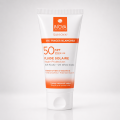
The basic recommendation is universal: SPF 50+ daily, reapplied every 2 hours during exposure. People of African origin tend to avoid mineral filters (zinc, titanium) that leave a visible white film, perceived as stigmatising. Laboratories such as IN'OYA have developed formulations specifically adapted to these concerns.
Regular ophthalmological monitoring
Specialist ophthalmological follow-up is essential from the first months of life. Early optical correction, orthoptic rehabilitation, and photophobia-adapted tinted lenses — these interventions significantly improve quality of visual life.
Dermatological screening
In high-prevalence countries such as Tanzania, community screening programmes have been introduced with significant results in the early detection of carcinomas. In Europe, albino individuals should benefit from an annual full-body dermatological check-up.
The golden rule
For albinos in Africa, wearing covering clothing, wide-brimmed hats, and systematically applying SPF 50+ from the earliest age are the most effective preventive measures against skin cancer.
09 — Comparative table
Summary: Black, mixed and Caucasian skin
| Criterion | Black skin (Sub-Saharan Africa) | Mixed skin (Mediterranean) | Caucasian skin (Northern Europe) |
|---|---|---|---|
| Dominant subtype | OCA2, OCA3 | OCA1, OCA2 | OCA1 |
| Prevalence | 1/1,400 to 1/10,000 | 1/10,000 to 1/15,000 | 1/17,000 to 1/20,000 |
| Skin colour | Cream, pinkish, sometimes golden | Very fair, ivory | Ivory white, pale pink |
| Hair colour | Yellow, golden, reddish (OCA3) | Light blond to white | White or very blond |
| Residual melanin | Possible (OCA2) | Low (OCA1b) to absent (OCA1a) | Absent (OCA1a) |
| Skin cancer risk | Extremely high | High | Moderate to high |
| Societal risk | Very high (stigma, violence) | Moderate | Low |
| Access to care | Limited | Variable | Generally good |
Conclusion
A universal condition, with profoundly different challenges
Albinism is both universal in its biological mechanisms and profoundly variable in its clinical manifestations and human challenges. Acknowledging these specificities — particularly those of albinism in Africa — is a medical and ethical necessity.
Understanding why African albinos face multiplied risks, and supporting adapted care initiatives, lies at the heart of IN'OYA's mission.
Albinism in Africa — causes, specificities, management →Scientific sources & references: Witkop CJ Jr., Alabama J. Med. Sci. 1979 — Spritz RA., Semin Dermatol. 1993;12(3):167-172 — Lund PM., Clin Exp Dermatol. 2005;30(2):185-189 — Luande J. et al., Cancer. 1985;55(8):1823-1828 — Inagaki K. et al., Am J Hum Genet. 2004;74(3):466-471 — Grønskov K. et al., Orphanet J Rare Dis. 2007;2:43 — Aquaron R., Ophthalmic Paediatr Genet. 1990;11(4):255-263 — Manga P. et al., Am J Hum Genet. 1997;61:599-607 — Amnesty International, 2016 — Under the Same Sun (UTSS), 2023 — Oetting WS. & King RA., Hum Mutat. 1999;13(2):99-115 — WHO, Albinism — Fact sheet, 2022.
This article is for informational and educational purposes only. It does not replace medical advice. If in doubt, consult a dermatologist or a clinical geneticist.