
Albinism: Causes, Symptoms, Complications, and Care for Black, Olive, and Mixed-Race Skin
Article co-authored with Dr. Ibrahima Traoré, Dermatologist in Conakry (Guinea), who is actively involved in the care of people living with albinism, as well as skin cancer prevention and public awareness initiatives across Africa.

What Is Albinism?
Albinism is a rare genetic disorder characterized by reduced or absent production of melanin, the pigment responsible for the color of the skin, hair, and eyes. This condition occurs in every population worldwide, regardless of sex or ethnic background.
Contrary to common misconceptions, albinism is not contagious, is not caused by diet, and is not linked to any particular geographic origin. It is an autosomal recessive inherited disorder, meaning that both parents must carry the genetic mutation for a child to be affected.
The absence or significant reduction of melanin makes the skin highly sensitive to ultraviolet (UV) radiation, increases eye vulnerability, and raises the risk of developing skin lesions, particularly skin cancer. Early medical care and rigorous daily sun protection are therefore essential throughout life.
Key Takeaways
- ✔ Albinism is a rare genetic disorder.
- ✔ It significantly reduces melanin production.
- ✔ It greatly increases sensitivity to sunlight and UV radiation.
- ✔ Regular dermatological and ophthalmological care is essential.
- ✔ Daily SPF 50+ sun protection is strongly recommended.
Why Is Albinism Discussed in Black, Olive, and Mixed-Race Skin?
Although albinism occurs worldwide, certain subtypes are much more common among African populations. Oculocutaneous albinism type 2 (OCA2) and type 3 (OCA3) are particularly prevalent in people with Black, olive, or mixed-race skin. Their genetic and clinical characteristics differ from those typically observed in European populations.
In individuals who naturally have melanin-rich skin, these genetic mutations are often more noticeable. They alter the synthesis of eumelanin—the pigment responsible for darker skin tones—explaining the differences in pigmentation observed between the various forms of albinism.
IN'OYA Dermatologist's Advice
The absence of melanin makes the skin extremely vulnerable to UV radiation. For people living with albinism, daily application of SPF 50+ sunscreen, wearing protective clothing, and regular dermatological check-ups are the most effective ways to prevent precancerous lesions and skin cancer.
Protect Highly Sun-Sensitive Skin
Skin affected by albinism requires daily protection against UV rays. Discover IN'OYA's protective and moisturizing skincare products, specially designed for the most sensitive skin.
Why Is Melanin Essential?
Melanin does much more than give skin its color. It acts as a natural shield against ultraviolet radiation by helping protect skin cells from UV damage. When this natural protection is absent or greatly reduced—as in people living with albinism—the risk of sunburn, premature skin aging, and skin cancer increases significantly.
This is why prevention relies primarily on rigorous sun protection, regular medical monitoring, and skincare products specifically designed to meet the needs of fragile, sun-sensitive skin.
IN'OYA's Scientific Expertise
At IN'OYA, our educational content is developed in collaboration with healthcare professionals and is based on the latest scientific knowledge about melanin-rich skin. This article was co-authored with Dr. Ibrahima Traoré, a dermatologist in Guinea, to provide reliable information that reflects the realities faced by people living with albinism in Africa and around the world.
The Different Types of Albinism
Albinism is not a single condition but rather a group of inherited genetic disorders. Specialists classify the different forms according to the affected gene, the amount of melanin produced, and the clinical features observed. This classification helps explain why albinism varies from one person to another and allows healthcare professionals to provide more appropriate care.
To date, dozens of genetic mutations have been identified, but the four main types of oculocutaneous albinism (OCA) are the most commonly encountered in clinical practice.
| Type | Affected Gene | Main Characteristics |
|---|---|---|
| OCA1 | TYR (Tyrosinase) | Little or no melanin production, very fair skin, white hair, and light-colored eyes. |
| OCA2 | OCA2 | The most common type in Africa. Residual pigmentation, light brown skin, and gray or hazel eyes. |
| OCA3 | TYRP1 | Frequently found in African populations. Reddish hair, copper-colored skin, and brown eyes. |
| OCA4 | SLC45A2 | More common in Asia and clinically similar to OCA2. |
Why Are Certain Types of Albinism More Common in Africa?
The distribution of albinism varies across different regions of the world. In sub-Saharan Africa, OCA2 and OCA3 are significantly more common than in European populations. This difference is linked to the higher prevalence of certain inherited genetic mutations within these populations.
As a result, albinism in people of African descent is not always identical to the forms observed in individuals of European ancestry. The biological mechanisms involved differ, as does the amount of residual melanin produced.
IN'OYA Dermatologist's Advice
Not everyone living with albinism has the same degree of depigmentation. Some individuals retain a small amount of melanin production, which may influence their skin or hair color over time. However, their sensitivity to sunlight remains extremely high, making daily sun protection essential.
Why Does Melanin Play Such an Important Role?
In people without albinism, melanin acts as a natural biological defense against ultraviolet (UV) radiation. Produced by melanocytes, it absorbs part of the UV rays before they can damage skin cells.
When melanin production is greatly reduced, the skin becomes extremely vulnerable. Sunburn develops much more quickly, and UV damage accumulates over time, significantly increasing the risk of skin cancer.
Key Takeaways
- ✔ OCA2 and OCA3 are the most common forms of albinism in Africa.
- ✔ All types of albinism are inherited genetic disorders.
- ✔ The amount of melanin produced varies depending on the genetic mutation.
- ✔ Daily sun protection is essential regardless of the type of albinism.
Protect Highly Sun-Sensitive Skin
People living with albinism need a daily routine that combines sun protection, hydration, and skincare designed to respect fragile skin. Discover the solutions developed by IN'OYA to support the needs of highly sensitive skin.
Is Albinism Only a Pigmentation Disorder?
No. Although depigmentation is the most visible feature of the condition, albinism also affects eye development and greatly increases the skin's sensitivity to ultraviolet radiation. This is why comprehensive medical care—including a dermatologist, an ophthalmologist, and a primary care physician—is recommended from early childhood.
In the next section, we will explore the main skin and eye complications of albinism, as well as its impact on quality of life, to better understand why regular medical follow-up is so important.
What Are the Complications of Albinism?
Albinism is more than a lack of skin pigmentation. The absence or reduced amount of melanin affects several organs, particularly the skin and eyes. Without appropriate preventive care, complications can develop from an early age and worsen over time.
The main complications are dermatological and ophthalmological, and they can also have a significant impact on daily life, education, and professional opportunities.
Skin Complications
In people living with albinism, the skin is far more vulnerable to ultraviolet (UV) radiation. Without sufficient melanin, skin cells have much less natural protection against sun damage. Over time, this increased vulnerability promotes the development of a variety of skin conditions.
| Complication | Description |
|---|---|
| Sunburn | Develops quickly after exposure to UV radiation. |
| Dry Skin | The skin becomes rougher, more sensitive, and uncomfortable. |
| Actinic Keratoses | Precancerous skin lesions caused by chronic sun exposure. |
| Localized Hyperpigmentation | Some areas may develop dark spots despite the reduced melanin associated with albinism. |
| Skin Cancer | The risk of skin carcinoma is significantly higher without adequate sun protection. |
For people living in regions with intense year-round sunlight, particularly in sub-Saharan Africa, skin cancer is one of the most serious complications associated with albinism. Regular dermatological examinations are therefore essential.
IN'OYA Dermatologist's Advice
Any new skin lesion that bleeds, a persistent scab, or a wound that does not heal should be evaluated promptly by a dermatologist. Early detection allows most skin cancers to be treated effectively.
Eye Complications
Melanin also plays a crucial role in normal eye development. Its absence leads to visual abnormalities that are present from birth, with severity varying depending on the type of albinism.
| Condition | Consequences |
|---|---|
| Photophobia | Extreme sensitivity to light. |
| Nystagmus | Involuntary eye movements. |
| Strabismus | Misalignment of the eyes. |
| Reduced Visual Acuity | Impaired vision requiring specialized ophthalmological care. |
These visual disorders explain why regular ophthalmological follow-up is essential from early childhood to improve visual comfort, independence, and overall quality of life.
Protecting Your Skin Every Day Makes All the Difference
Prevention remains the most effective way to reduce the skin complications associated with albinism. High-SPF sun protection, daily hydration, and skincare tailored to sensitive skin help preserve long-term skin health.
The Impact of Albinism on Daily Life
Beyond its medical complications, albinism can significantly affect quality of life. Visual impairments may make school, certain occupations, and even driving more challenging. In many parts of the world, people living with albinism also continue to face discrimination, stigma, and misconceptions that can hinder their social inclusion.
Comprehensive medical, psychological, and social support can greatly improve independence and well-being. Patient advocacy organizations also play a vital role in raising awareness, providing education, and defending the rights of people living with albinism.
Key Takeaways
- ✔ Most skin complications are caused by UV exposure.
- ✔ Visual disorders require early and regular ophthalmological care.
- ✔ The risk of skin cancer is significantly increased.
- ✔ Daily sun protection remains the best preventive measure.
How Is Albinism Managed?
There is currently no cure for albinism. Management therefore focuses on prevention, aiming to reduce skin and eye complications while improving the quality of life of people living with the condition.
People with albinism have the same fundamental skincare needs as anyone else. However, because of their reduced melanin levels, they require much greater protection from the sun and regular medical follow-up. The primary goals are to prevent skin cancer, preserve vision, and maintain healthy skin.
The Pillars of Albinism Management
- ✔ Regular appointments with a dermatologist.
- ✔ Ophthalmological follow-up from early childhood.
- ✔ Daily application of broad-spectrum SPF 50+ sunscreen.
- ✔ Daily use of moisturizing skincare to maintain the skin barrier.
- ✔ Protective clothing, a wide-brimmed hat, and UV-blocking sunglasses.
- ✔ Avoid prolonged sun exposure between 12 p.m. and 4 p.m., when UV radiation is at its strongest.
Why Is the Sun the Greatest Threat to People Living with Albinism?
Melanin acts as a natural filter against ultraviolet (UV) radiation. In people living with albinism, this natural protection is greatly reduced—or even absent. As a result, UV rays penetrate the skin more easily and cause significantly greater cellular damage.
Repeated sun exposure increases the risk of sunburn, accelerates skin aging, and promotes the development of actinic keratoses and skin cancer. In regions with intense sunlight, such as many parts of Africa, this vulnerability represents a major public health challenge.
IN'OYA Dermatologist's Advice
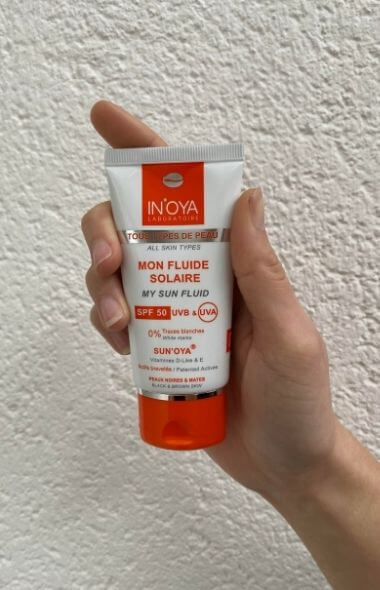
Sun protection should never be limited to summer days. UV rays penetrate clouds and can damage the skin even when the weather appears overcast. A broad-spectrum SPF 50+ sunscreen, reapplied every two hours during sun exposure, remains essential throughout the year.
Daily Protection Is Essential
Skin affected by albinism requires protective and moisturizing skincare specifically formulated to minimize UV damage while maintaining daily comfort and skin health.
Discrimination and Violence Against People with Albinism in Africa
Beyond the medical challenges, many people living with albinism continue to experience discrimination, prejudice, and, in some cases, violence. In several African countries, persistent traditional beliefs and myths still contribute to stigmatization and place affected individuals at serious risk.
Over the past few years, awareness campaigns, patient advocacy organizations, and healthcare professionals have played an essential role in improving public understanding of this genetic condition. These efforts are gradually helping to dispel misconceptions and promote greater social inclusion.
Despite this progress, many people with albinism continue to face violence, discrimination, and limited access to healthcare. Ongoing support from local organizations, healthcare providers, and public authorities remains essential to improving their safety, health, and quality of life.
Dr. Ibrahima Traoré's Commitment
As a dermatologist based in Conakry, Guinea, Dr. Ibrahima Traoré actively participates in awareness initiatives for people living with albinism. His work focuses on preventing skin cancer, providing therapeutic education, and improving access to dermatological care.
Frequently Asked Questions
IN'OYA Dermatologist's Advice
For people living with albinism, prevention should begin in early childhood and continue throughout life. Sun protection, protective clothing, and regular medical follow-up should not be limited to vacations or summer months. Any unusual change in the skin should be evaluated promptly by a healthcare professional.
This article was co-authored with Dr. Ibrahima Traoré, a dermatologist based in Conakry, Guinea, who is actively involved in raising awareness, preventing skin cancer, and providing dermatological care for people living with albinism.
Protect and Moisturize Highly Sensitive Skin
A tailored skincare routine helps preserve skin comfort while strengthening the skin's daily protective barrier. Discover IN'OYA skincare products designed to hydrate and protect fragile, sun-sensitive skin.
IN'OYA's Scientific Expertise
IN'OYA is a French laboratory specializing in the study and care of Black, olive, and mixed-race skin. The educational content published on OYAMAG is based on current dermatological knowledge and enriched by the expertise of healthcare professionals.
This article was co-authored with Dr. Ibrahima Traoré, combining scientific evidence with the medical, social, and environmental realities experienced by people living with albinism in Guinea and across Africa.
Sources and References
This article is based on information from internationally recognized health organizations, reference centers, and associations specializing in albinism.
- World Health Organization (WHO) – Albinism
- Orphanet – Rare Diseases and Albinism
- GeneReviews® – Oculocutaneous Albinism and Ocular Albinism Overview
- United Nations – International Albinism Awareness Day
- Genespoir – French Albinism Association
Medical Disclaimer: This article is provided for informational purposes only and does not replace professional medical advice. If you notice a skin lesion, vision changes, severe sunburn, or have any other health concerns, consult a dermatologist, ophthalmologist, or your healthcare provider.
Key Takeaways
Albinism is a rare genetic disorder that affects melanin production, making the skin and eyes highly sensitive. Daily sun protection, appropriate clothing, and regular dermatological and ophthalmological care are essential for reducing complications.
Education, public awareness, and the fight against discrimination are equally important to improving the health, safety, and quality of life of people living with albinism.
Need Personalized Skincare Advice?
Take the free IN'OYA Skin Assessment to better understand your skin's needs and discover a personalized selection of skincare products.